A Well-Regulated Militia by Saul Cornell
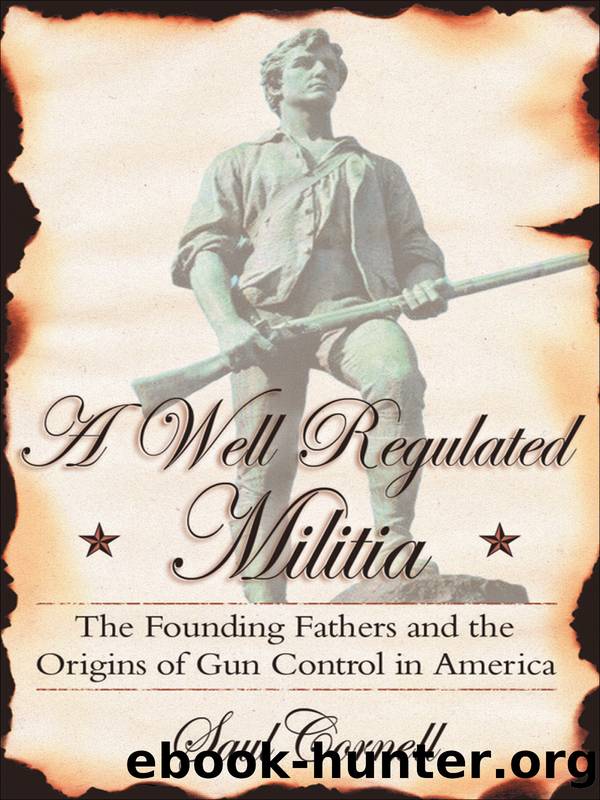
Author:Saul Cornell [Cornell, Saul]
Language: eng
Format: epub
ISBN: 9780195147865
Publisher: OxfordUP
Published: 2006-09-15T05:00:00+00:00
A man in the pursuit of deer, elk, and buffaloes, might carry his rifle every day, for forty years, and yet, it would never be said of him, that had borne arms, much less could it be said, that a private citizen bears arms, because he has a dirk, or pistol concealed under his clothes, or a spear in a cane.
Although the court acknowledged that militia weapons were constitutionally protected, it accepted that the state could still regulate the manner in which these weapons might be kept or borne. Weapons that had little connection to military preparedness were not given any constitutional protection. In the view of the Aymette court, the legislature enjoyed the widest possible latitude to regulate pistols or other weapons that had negligible value in promoting the maintenance of a well-regulated militia.17
Two years later, in State v. Buzzard, the Arkansas Supreme Court refined the civic model advanced in Aymette. Invoking a concept central to Anglo-American jurisprudence since Blackstone, the court wrote that the goal of the Constitution was to protect those rights âessential to the enjoyment of well-regulated liberty.â To conclude, as had the court in Bliss, that the right to bear arms was not subject to reasonable regulation was to encourage anarchy, not liberty. Regulation of weapons was a legitimate and necessary exercise of the state's police powers. The decision reiterated that the purpose of bearing arms was not to âenable each member of the community to protect and defend by individual force his private rights against every illegal invasion.â Protection of this estimable right was intended to âenable the militia to dischargeâ their important public trust. One of the most interesting features of the decision was its frank recognition that two competing models of the right to bear arms had emerged under state constitutional law. Although some states had embraced a more expansive individual rights conception of arms bearing, the court took judicial notice of the fact that neither the Arkansas state constitution nor the federal Bill of Rights had employed this more individualistic formulation of the right.18
Additional evidence that American law was divided over the meaning and scope of the right to bear arms and its connection to the right of self-defense may be found in the notorious 1852 Kentucky murder trial of Mattews Ward. In contrast to Reynolds and Selfridge, which were both closely connected to bitter partisan conflicts of the Jeffersonian era, the Ward case was not linked to animosities stoked by party rage. Sadly, the events that triggered the fatal confrontation between Ward and his brother's teacher, William Butler, were almost trivial. The incident began over a bunch of chestnuts. The stern teacher had confronted the younger Ward boy about eating during class. When William Ward denied having consumed the chestnuts, Butler called him a liar and whipped him, a severe but not unusual form of school discipline in the mid-nineteenth century. The next day the boy's brother, Mattews Ward purchased two small pistols and returned to the school with William and another brother, Bob, to confront the teacher.
Download
This site does not store any files on its server. We only index and link to content provided by other sites. Please contact the content providers to delete copyright contents if any and email us, we'll remove relevant links or contents immediately.
The Secret History by Donna Tartt(19086)
The Social Justice Warrior Handbook by Lisa De Pasquale(12190)
Thirteen Reasons Why by Jay Asher(8909)
This Is How You Lose Her by Junot Diaz(6886)
Weapons of Math Destruction by Cathy O'Neil(6279)
Zero to One by Peter Thiel(5801)
Beartown by Fredrik Backman(5754)
The Myth of the Strong Leader by Archie Brown(5507)
The Fire Next Time by James Baldwin(5442)
How Democracies Die by Steven Levitsky & Daniel Ziblatt(5218)
Promise Me, Dad by Joe Biden(5153)
Stone's Rules by Roger Stone(5087)
A Higher Loyalty: Truth, Lies, and Leadership by James Comey(4962)
100 Deadly Skills by Clint Emerson(4925)
Rise and Kill First by Ronen Bergman(4788)
Secrecy World by Jake Bernstein(4753)
The David Icke Guide to the Global Conspiracy (and how to end it) by David Icke(4717)
The Farm by Tom Rob Smith(4507)
The Doomsday Machine by Daniel Ellsberg(4490)
